
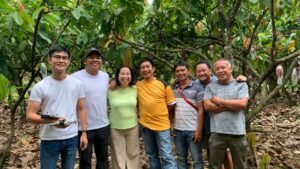
Agriculture in the Philippines is increasingly shaped by climate uncertainty. Shifting rainfall patterns, prolonged dry periods, and rising disease risks are placing growing pressure on farming systems particularly in high-value crops such as cacao.
For many farmers, decisions are still based on periodic field observations and experience. While this knowledge remains essential, the speed and complexity of climate-related risks today require more timely and continuous insights.
To address this gap, SpaceCrop is deploying its climate intelligence platform across cacao farming communities, integrating satellite imageries, climate data, and field-level validation to support more informed and proactive decision-making.
SpaceCrop’s approach combines multi-spectral satellite imagery with climate and environmental data to provide continuous monitoring of crop conditions. Using various data sources, SpaceCrop can detect early signals of crop stress, often before visible symptoms appear in the field.
These insights are further enriched by integrating soil moisture dynamics, rainfall variability, and temperature patterns. Through GeoAI models, these datasets are transformed into actionable intelligence allowing farmers and cooperatives to identify emerging risks, monitor crop health trends, and prioritize interventions across different areas of the farm.
In cacao systems, variability within farms such as differences in soil conditions, elevation, and canopy cover can significantly influence crop performance. Traditional monitoring methods may not capture these variations at scale.
By mapping spatial variability across farms and generating alerts when anomalies are detected, SpaceCrop enables more targeted interventions. Farmers can adjust biocontrol applications, inspect specific zones, or respond earlier to potential disease risks. Acting within this critical window can reduce potential losses and improve crop outcomes.
Beyond individual farms, the deployment of SpaceCrop’s platform supports improved coordination at the cooperative level. Aggregated insights across multiple farms allow cooperatives to monitor broader trends, allocate resources more efficiently, and strengthen traceability within the value chain. This is particularly important for cacao, where consistency, quality, and transparency are essential for market access.
With better visibility across farming systems, cooperatives are better equipped to implement coordinated, data-driven strategies that improve both productivity and resilience.
SpaceCrop’s work in the Philippines reflects a broader effort to develop scalable solutions for climate-resilient agriculture. By integrating satellite remote sensing, remote virtual sensors, climate data, and GeoAI modeling, SpaceCrop provides a foundation for continuous monitoring and predictive insights across diverse agricultural environments.
As climate risks continue to intensify, access to timely and reliable data will be critical in supporting farmers, cooperatives, and agricultural stakeholders. Through ongoing deployments and partnerships, SpaceCrop aims to contribute to a more resilient, data-driven agricultural system, one that enables earlier action, better resource management, and improved long-term sustainability.
Watch How It Works
Learn more about how SpaceCrop is supporting cacao farmers, link here.